
11 min and 59 sec to read, 2996 words
Two-Shot Molding vs. Overmolding: What You Need to Know
If you’re seeking a clear difference between two-shot molding and overmolding, the answer is that both processes create multi-material parts, but each offers unique advantages suited to specific designs and product needs.
Imagine you’re launching a new product line that relies heavily on comfortable grips or intricate housings—only to face repeated issues with product failures or inconsistent finishes. You know your team needs a single process that delivers both performance and design flexibility, yet uncertainty about the right plastic molding approach stalls your progress. The cost of errors looms large, impacting time to market, budget, and your brand’s reputation. Luckily, understanding the practical comparison between 2K VS Over moulding provides the essential roadmap to making informed, cost-effective manufacturing decisions.
What Are the Key Differences Between 2K VS Over moulding Processes?
![Photorealistic cross-section image of a multi-material component showing two-shot molding and overmolding process in action, with resin flows and tool parts labeled.]
The main distinction is how and when each technique joins materials. Both serve to combine two polymers into a single part, but in 2K VS Over moulding, each process deploys unique tooling and sequence. For instance, in two-shot molding, two resins are injected sequentially into a single mold during one cycle. For overmolding, parts are first molded, then repositioned or transferred as a substrate for secondary molding.
Learn more about the details at www.fymold.com .
Why Does Process Choice Matter for Your Project’s Success?
- It affects product performance, appearance, and cost.
- It determines assembly time and scalability.
- It influences the materials you can use.
The right process depends on your priorities for design complexity, material compatibility, cycle times, and costs.
Bucket Brigade: Let’s dive deeper to see which process fits different manufacturing demands.
What Are the Core Steps in Each Method?
- Two-shot molding: one cycle, two injections, no part transfer.
- Overmolding: initial part made, then used as an insert for secondary molding.
Bucket Brigade: Understanding these steps helps you forecast project lead times accurately.
Key Takeaway
Precise process selection is vital to optimize both your end product and your per-unit costs.
| Process | Materials Combined | Tooling Need | Cycle Time | Typical Application | |
|---|---|---|---|---|---|
| 2K Molding | Yes | Complex 2-shot mold | Fast | Seamless multi-resins | |
| Overmolding | Yes | Two related molds | Slower | Soft touch, insert add |
Carefully weigh these differences when planning your next tooling investment.
How Does 2K VS Over moulding Impact Material Selection?
![Photorealistic sample swatches of compatible and incompatible polymers with notations showing strong and weak bonding, emphasizing chemical compatibility.]
Both methods demand careful material selection, but 2K VS Over moulding emphasizes chemical compatibility and adhesion. 2K molding often uses materials designed to bond well in a single heated mold, while overmolding must ensure the secondary material bonds to the cooled substrate.
Explore more about selecting proper resin pairs on our material compatibility page .
What Factors Should Guide My Material Choices?
- Chemical adhesion: Will both materials bond securely?
- Heat sensitivity: Can the substrate withstand another molding cycle?
- Application requirements: Do you need waterproofing, vibration resistance, or aesthetics?
Bucket Brigade: Picking the ideal pair reduces failure risk and warranty claims.
Are There Common Issues With Poor Material Choices?
- Delamination or peeling.
- Cosmetic defects or weak seals.
- Early end-of-life for the finished part.
Bucket Brigade: Overcome these issues with expert material matching.
Key Takeaway
Material choice is foundational—poor pairing can compromise your product’s integrity.
| Compatible Pairings | Result | Risk if Mismatched | |
|---|---|---|---|
| ABS + TPE | Excellent | Adhesion failure | |
| PC + Elastomer | Good | Warping | |
| Nylon + Polypropylene | Limited | Delamination |
Consult with specialists early to avoid costly redesigns.
Which Products Are Best Made by 2K VS Over moulding?
![Photo showing real-world products like toothbrushes (2K-molded) and phone cases (overmolded), labeled for clarity.]
The best candidates are multicomponent parts demanding robust bonding and precision. In 2K VS Over moulding, 2K shines for high-volume, multi-color technical parts, while overmolding suits grip enhancements or soft overlays.
Unlock more sample applications on our case studies page .
How Do These Methods Elevate Product Performance?
- Enhanced ergonomics (soft touch grips)
- Sealed electronics (dual-barrier housings)
- Distinctive branding (color/texture contrasts)
Bucket Brigade: Think about both aesthetics and functionality as you design.
What Are Perfect-Example Use Cases?
- 2K: Multi-color buttons, medical devices.
- Overmolding: Tool handles, protective bumpers.
Bucket Brigade: Each option plays a unique role in product portfolios.
Key Takeaway
Targeted use of either method results in stronger, more attractive, and user-friendly products.
| Product Type | Best Process | Reason | |
|---|---|---|---|
| High-volume keys | 2K | Consistency, speed | |
| Soft power tools | Overmolding | Grip comfort | |
| Sealed electronics | Both | Waterproofing, labeling |
Match process to product needs for maximum market appeal.
What Are the Main Cost Considerations for 2K VS Over moulding Projects?
![Photorealistic bar chart comparing tooling, per-part, and overall costs of 2K molding, overmolding, and traditional assembly methods.]
The process you choose has a direct impact on your spend, as seen in 2K VS Over moulding case studies. Two-shot molding generally demands higher up-front tool investment, but pays off with lower per-unit costs for large runs. Overmolding offers flexibility and lower initial costs, though cycle times and per-part costs may be higher.
Want a detailed quote? Get in touch with us today .
What Drives Tooling and Per-Part Costs?
- Mold complexity: 2K molds are precision-engineered, with higher initial costs.
- Cycle time: Faster for 2K, but overmolding is ideal for smaller runs.
- Scrap rate and assembly: Both typically lower than manual assembly.
Bucket Brigade: Don’t overlook lifetime cost savings from automation and waste reduction.
Is Automation Easier With Either Process?
- 2K: Supports fully automated production.
- Overmolding: Often semi-automatic or manual transfer.
Bucket Brigade: Consider your facility’s automation capability before deciding.
Key Takeaway
Up-front investment in 2K pays off in volume, while overmolding excels in flexibility and prototyping.
| Cost Metric | 2K Molding | Overmolding | |
|---|---|---|---|
| Tooling | High (complex) | Medium (2 molds) | |
| Per-part | Low (large runs) | Higher (slower) | |
| ROI Timeframe | Short (high vol.) | Longer (low vol.) |
Match investment to your forecast production quantity for best returns.
What Are the Cycle Time and Production Differences?
![Photorealistic assembly line showing automated two-shot molding versus manual overmolding station, both in use.]
Cycle time efficiency varies greatly in 2K VS Over moulding. Two-shot molding usually delivers lower total production time per piece by eliminating manual handling, while overmolding may add extra steps due to substrate transfer.
Review our manufacturing process overview for more on automation options.
How Do You Forecast Lead Time?
- 2K: Single cycle, fully automated = fast output.
- Overmolding: Multiple cycles, manual or robotic transfer = slower.
Bucket Brigade: Your delivery deadlines should influence your process decision.
Does Batch Size Affect Productivity?
- Larger batches favor 2K for efficiency.
- Smaller or custom runs favor overmolding for flexibility.
Bucket Brigade: Adjust your method as your business scales.
Key Takeaway
Save time with 2K in high-volume settings; opt for overmolding where flexibility is critical.
| Cycle Time Metric | 2K Molding | Overmolding | |
|---|---|---|---|
| Per-part Time | Low | Higher | |
| Handling Needed | Minimal | More | |
| Setup for Change | Harder | Easier |
Align your method to both current and future capacity needs.
What Are the Most Common Defects in 2K VS Over moulding, and How Do I Prevent Them?
![Photorealistic quality control inspection scene: technician examining both 2K and overmolded parts under bright lights.]
Both techniques can introduce specific quality control concerns—especially if material or process selection falters in 2K VS Over moulding applications. Issues like poor adhesion, flashing, or warping are common but can be minimized with the right expertise.
Discover more about our quality control systems .
What Issues Should You Watch Out For?
- Delamination or weak bonding
- Warpage, bubbles, or voids
- Inconsistent color transitions
Bucket Brigade: Proactive tool design and process tweaks minimize these risks.
How Can You Troubleshoot These Defects?
- Test adhesion before production ramp-up.
- Use simulation to optimize flow, venting, and tool temperature settings.
Bucket Brigade: Preventative action saves time, materials, and customer complaints.
Key Takeaway
Quality is determined as much by planning as by execution—don’t skimp on pre-production validation.
| Defect Type | Prevention Tip | |
|---|---|---|
| Delamination | Vet resin pairs, optimize cycle | |
| Flash or Burrs | Tight tolerances in tool design | |
| Inconsistent Color | Balanced injection sequence |
Building in time for trials pays back in far fewer rejects.
How Do 2K VS Over moulding Processes Support Sustainable Manufacturing?
![A photorealistic “green factory” with inspection robots and bins for recycled polymers, featuring molded parts in different colors, and clear eco-label highlights. Data chart overlays show recycled content percentages for each method.]
Sustainability is a core concern in 2K VS Over moulding design today. Two-shot molding streamlines production, minimizing material waste and reducing secondary operations. Overmolding itself can incorporate recycled inserts or substrates, opening doors to circular product strategies.
See our sustainable solutions at fymold.com sustainability hub .
In What Ways Do These Methods Cut Waste?
- Fewer process steps mean less scrap.
- More automation limits human error and wasteful rejects.
Bucket Brigade: Every part of your project should serve both your users and the environment.
Can You Use Recycled or Bio-Based Plastics?
- 2K: Some bioplastics and recycled blends are eligible with proper bonding.
- Overmolding: Many substrates can be reused or upcycled.
Bucket Brigade: Explore greener alternatives to earn eco-conscious market share.
Key Takeaway
Both processes offer avenues to boost your product sustainability and brand image.
| Sustainability Factor | 2K Molding | Overmolding | |
|---|---|---|---|
| Scrap output | Low | Moderate | |
| Recycled options | Possible | Possible | |
| Energy efficiency | High | High (if automated) |
Your process choice can be a selling point in a competitive, eco-focused market.
How Do You Specify and Source the Right Tooling Partner for 2K VS Over moulding?
![Photo of a state-of-the-art toolroom with CNC machines, precision gauges, and sample complex molds on display.]
Selecting the right tooling partner is critical for project success in 2K VS Over moulding. Look for partners with proven expertise, robust quality systems, and quick-response support for long-term wins.
Start your partner search with our vetted supplier network at www.fymold.com .
What’s Most Important in Vendor Evaluation?
- In-house design and mold-building skills
- Strong project management track record
- Capability for rapid prototyping and production validation
Bucket Brigade: Don’t settle for less—partner quality directly affects your product.
How Can You Confirm a Partner’s Capabilities?
- Ask for process certifications and tooling samples.
- Visit facilities and review client references.
Bucket Brigade: Invest time up front to avoid downstream regret or costly delays.
Key Takeaway
Proven expertise and responsive support are non-negotiable for process success.
| Partner Criteria | Must Have | Nice to Have | |
|---|---|---|---|
| In-house tooling | ✔ | ||
| ISO certification | ✔ | ||
| Prototyping service | ✔ |
The right partner strengthens your supply chain resilience and innovation potential.
What Design Tips Will Ensure Your 2K VS Over moulding Projects Succeed?
![A photorealistic digital rendering showing CAD software with multi-material part geometry, annotations for shutoffs, draft angles, and material interface zones.]
Design for 2K VS Over moulding should start early—so both process and assembly challenges are addressed. Use digital modeling and simulation to validate critical features and plan gating, shut-offs, and interface zones.
For more on design support, visit our engineering resources hub .
What Are The Hardest Design Challenges?
- Managing material flow and bonding at complex interfaces
- Ensuring wall thickness uniformity
- Planning for vents and ejection without cosmetic marks
Bucket Brigade: Early design review eliminates rework surprises.
How Do You Optimize Tooling for Seamless Production?
- Use simulation to preview material behavior and refine gate locations.
- Plan for consistent draft angles and generous radii at interfaces.
Bucket Brigade: Design validation is your tool against project overruns.
Key Takeaway
The most efficient projects start with collaborative design and rigorous simulation.
| Design Guideline | 2K Molding | Overmolding | |
|---|---|---|---|
| Interface planning | Crucial | Crucial | |
| Simulation required | Yes | Yes | |
| Early DFM required | Yes | Yes |
Design well, and the rest falls into place with fewer iterations.
What Are the Latest Trends in 2K VS Over moulding Technology?
![Photorealistic ECharts dashboard illustration showing a rising trend line in tooling automation and adoption rate for 2K molding vs overmolding from 2016 to 2026.]
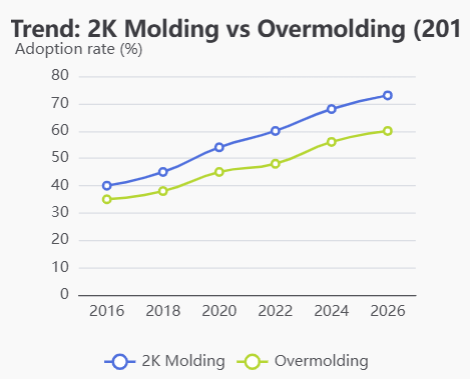
The field of 2K VS Over moulding evolves quickly, and you’ll see even more automation, digital simulation, and bio-plastics in the coming years. Industry is moving toward highly flexible tooling systems and rapid changeovers, plus predictive defect monitoring.
Stay ahead—explore the latest trends with our innovation resources .
What Innovations Should You Watch?
- Advanced simulation for design validation
- Integration of recycled, bio-based, and specialty polymers
Bucket Brigade: Future-proof your production lines with trend-based upgrades.
How Will These Trends Shape Your Decisions?
- Expect lower long-term costs as automation grows.
- Faster project delivery speeds fuel competitive advantage.
Bucket Brigade: Upgrade regularly to remain ahead of market expectations.
Key Takeaway
Stay informed and invest in new tech to maximize ROI and product performance.
| Trend | Near-Term Impact | Long-Term Advantage | |
|---|---|---|---|
| Digital twins | Early bug detection | Fewer recalls | |
| Automation | Rapid changeovers | Flexible production | |
| Bioplastics | Opens new markets | Brand sustainability |
Being proactive in trend adoption pays in both reputation and efficiency.
What’s the Expert Advice for First-Time Adopters of 2K VS Over moulding?
![Realistic photo of a consulting engineer in a lab, discussing options for 2K vs overmolding at a digital whiteboard with a client.]
Navigating your first 2K VS Over moulding project is simpler with the right approach. Experts recommend thorough consultations with design, materials, and tooling specialists before capital investment.
Tap into our free project consultation resources for guidance.
Where Should You Begin?
- Define your product specs and priorities up front.
- Request a DFM (Design for Manufacturability) review.
- Validate materials with small test runs.
Bucket Brigade: The clarity of your upfront planning drives production success.
What Pitfalls Can You Avoid?
- Rushing into tooling before material trials.
- Skipping partner capability checks.
- Failing to budget for process validation.
Bucket Brigade: Expert partnership streamlines learning and trims risk.
Key Takeaway
Smart, early engagement with specialists saves both money and stress.
| New Adopter Task | Why It Matters | |
|---|---|---|
| Conduct trials | Proves material fit | |
| DFM review | Prevents tooling issues | |
| Pick right partner | Ensures steady delivery |
Progress faster by leveraging industry expertise—from concept to launch.
Conclusion
If you’ve struggled to choose between 2K and overmolding, this guide equips you to minimize risk, cut costs, and deliver robust, visually compelling products with confidence. You now understand the practical differences, cost impacts, defect prevention, and design best practices for these essential plastic molding options. Ready for the next step? Contact us today to discuss your project or tap into our full-service design and manufacturing solutions—our team is committed to powering innovation and quality in every product you produce. At FYMold, we believe in shaping a smarter, more sustainable future—together.
FAQ
Can I use two-shot molding for low-volume runs?
Usually not a cost-effective choice. Two-shot molding’s tooling costs are best justified for high production volumes; consider overmolding or conventional molding for low runs.
What’s the best way to choose between 2K VS Over moulding?
Start with your part’s requirements. If you need fast cycles and high accuracy for large batches, go 2K; if flexibility or secondary material overlays matter most, use overmolding.
How do I know if my part needs an adhesive or special primer for overmolding?
Check with your materials supplier. If your resin selection lacks natural adhesion, a primer may improve bond strength—testing is essential up front.
Can I switch from overmolding to 2K mid-project?
Only with design and tooling changes. It’s possible but may require new molds and minor part redesign; proper planning avoids costly transitions.
What’s the difference in lead time for each process?
2K molding is faster for large batches. Overmolding may extend timelines due to manual or semi-automated transfer steps.
The field of 2K VS Over moulding evolves quickly, and you’ll see even more automation, digital simulation, and bio-plastics in the coming years. Industry is moving toward highly flexible tooling systems and rapid changeovers, plus predictive defect monitoring.
Stay ahead—explore the latest trends with our innovation resources .
### What Innovations Should You Watch?
- Advanced simulation for design validation
- Integration of recycled, bio-based, and specialty polymers
Bucket Brigade: Future-proof your production lines with trend-based upgrades.
### How Will These Trends Shape Your Decisions?
- Expect lower long-term costs as automation grows.
- Faster project delivery speeds fuel competitive advantage.
Bucket Brigade: Upgrade regularly to remain ahead of market expectations.
### Key Takeaway
Stay informed and invest in new tech to maximize ROI and product performance.
| Trend | Near-Term Impact | Long-Term Advantage | |
|---|---|---|---|
| Digital twins | Early bug detection | Fewer recalls | |
| Automation | Rapid changeovers | Flexible production | |
| Bioplastics | Opens new markets | Brand sustainability |
Being proactive in trend adoption pays in both reputation and efficiency.
## What’s the Expert Advice for First-Time Adopters of 2K VS Over moulding?
![Realistic photo of a consulting engineer in a lab, discussing options for 2K vs overmolding at a digital whiteboard with a client.]
Navigating your first 2K VS Over moulding project is simpler with the right approach. Experts recommend thorough consultations with design, materials, and tooling specialists before capital investment.
Tap into our free project consultation resources for guidance.
### Where Should You Begin?
- Define your product specs and priorities up front.
- Request a DFM (Design for Manufacturability) review.
- Validate materials with small test runs.
Bucket Brigade: The clarity of your upfront planning drives production success.
### What Pitfalls Can You Avoid?
- Rushing into tooling before material trials.
- Skipping partner capability checks.
- Failing to budget for process validation.
Bucket Brigade: Expert partnership streamlines learning and trims risk.
### Key Takeaway
Smart, early engagement with specialists saves both money and stress.
| New Adopter Task | Why It Matters | |
|---|---|---|
| Conduct trials | Proves material fit | |
| DFM review | Prevents tooling issues | |
| Pick right partner | Ensures steady delivery |
Progress faster by leveraging industry expertise—from concept to launch.
Conclusion
If you’ve struggled to choose between 2K and overmolding, this guide equips you to minimize risk, cut costs, and deliver robust, visually compelling products with confidence. You now understand the practical differences, cost impacts, defect prevention, and design best practices for these essential plastic molding options. Ready for the next step? Contact us today to discuss your project or tap into our full-service design and manufacturing solutions—our team is committed to powering innovation and quality in every product you produce. At FYMold, we believe in shaping a smarter, more sustainable future—together.
FAQ
Can I use two-shot molding for low-volume runs?
Usually not a cost-effective choice. Two-shot molding’s tooling costs are best justified for high production volumes; consider overmolding or conventional molding for low runs.
What’s the best way to choose between 2K VS Over moulding?
Start with your part’s requirements. If you need fast cycles and high accuracy for large batches, go 2K; if flexibility or secondary material overlays matter most, use overmolding.
How do I know if my part needs an adhesive or special primer for overmolding?
Check with your materials supplier. If your resin selection lacks natural adhesion, a primer may improve bond strength—testing is essential up front.
Can I switch from overmolding to 2K mid-project?
Only with design and tooling changes. It’s possible but may require new molds and minor part redesign; proper planning avoids costly transitions.
What’s the difference in lead time for each process?
2K molding is faster for large batches. Overmolding may extend timelines due to manual or semi-automated transfer steps.